English| EUR
Suggested for you
More currencies
Choose a language
Truffle hunting in Alba is a private, guided forest experience where a trifolau—a licensed truffle hunter—leads you and a trained Lagotto Romagnolo through the Langhe Hills in search of buried tuber magnatum. The activity runs year-round, with peak white truffle season from October through December. Hunts depart from meeting points in the wooded valleys surrounding Alba, and most tours include tasting.
Quick answer
Truffle hunting in Italy is a centuries-old foraging tradition in which licensed hunters, called trifolai, work with specially trained dogs to locate truffles buried beneath oak, hazel, and poplar roots in woodland terrain. In Alba, the practice centers on the prized white truffle of Piedmont, which grows wild in the clay-limestone soils of the Langhe Hills. Hunts are private or small-group experiences led by local trifolai, typically lasting two to three hours and concluding with a tasting of the day's find.
White truffles cannot be cultivated. Every specimen sold at Alba's annual truffle fair was found by a dog trained to detect the scent of tuber magnatum through thirty centimeters of forest floor. The tradition of truffle hunting in the Langhe dates to the fourteenth century, when Piedmontese farmers began formalizing agreements with landowners to harvest the underground fungus during autumn months. Today, the practice remains largely unchanged: a trifolau walks the woods with a small spade, a basket, and a dog whose lineage has been selected for scent work over generations. The Lagotto Romagnolo, originally bred as a water retriever in Romagna, is now the most common truffle dog in Italy. Training begins at eight weeks and continues for eighteen months, during which the dog learns to signal the presence of truffle scent without disturbing the mycelium network that produces future growth. The trifolau digs carefully, often on hands and knees, to extract the truffle without damaging neighboring root systems. A single mature oak can yield truffles for decades if the soil ecology remains intact. Alba's truffle hunting experiences are private tours arranged through local agriturismi and truffle associations. Participants meet the trifolau at a trailhead in the Langhe Hills, walk two to four kilometers through mixed hardwood forest, and observe the dog's search pattern as it quarters the terrain. When the dog signals, the trifolau confirms the find by scent before excavating. Successful hunts typically uncover between three and eight truffles, depending on season and soil moisture. Most tours conclude at a farmhouse where the day's harvest is shaved over fresh pasta or eggs. The white truffle season runs from late September through January, with peak aroma occurring in October and November when overnight temperatures drop below ten degrees Celsius. Black truffle varieties are present in the same terrain from May through August. Hunts depart in early morning or late afternoon to avoid midday heat, which diminishes scent dispersion. The experience requires moderate fitness, as trails are uneven and sometimes steep. Closed-toe footwear and layered clothing are necessary; the forest floor remains damp even in dry weather.
“A single mature oak can yield truffles for decades if the soil ecology remains intact.”
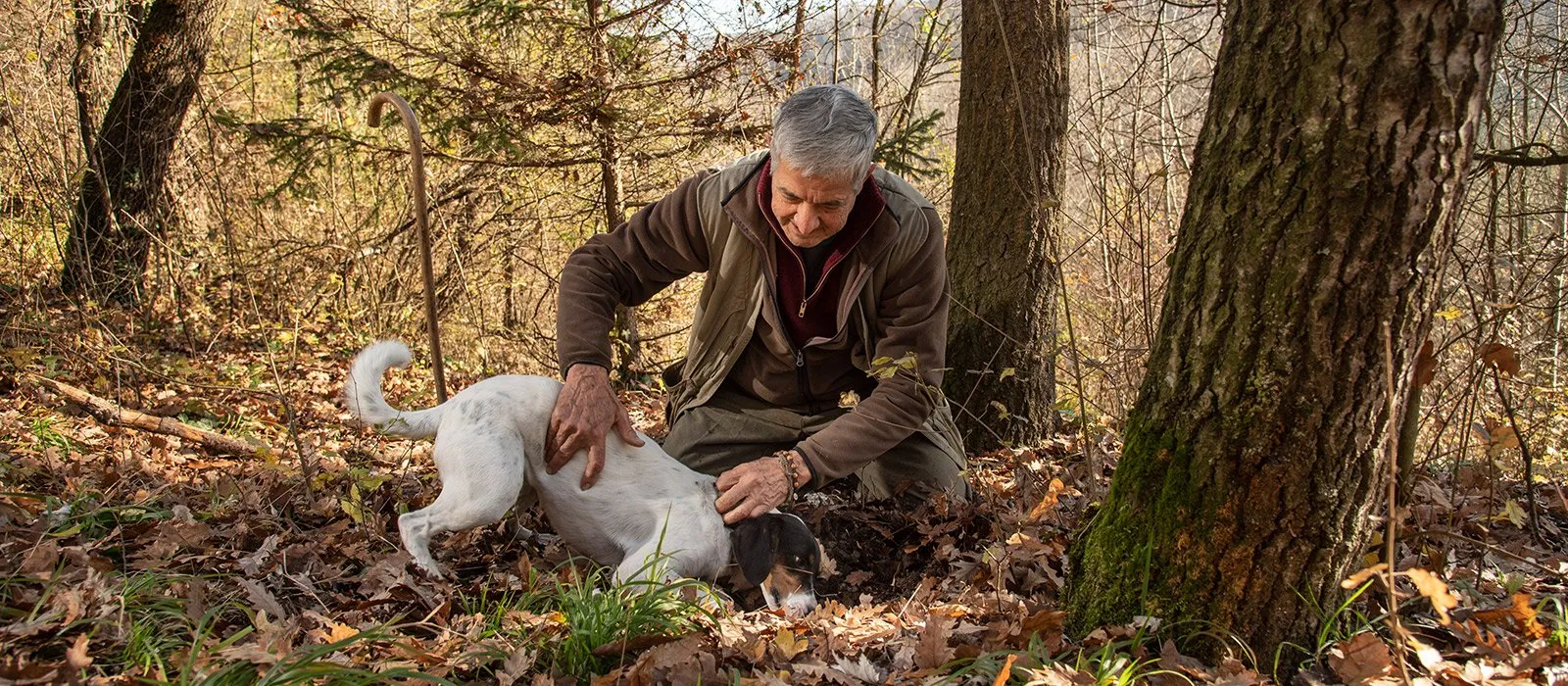
Truffle hunting in Alba follows a centuries-old ritual led by a trifolau and their trained dog through the Langhe woodlands. The search typically lasts two to three hours, moving quietly through oak and hazelnut groves where white truffles grow beneath the soil.
Arrive at the designated meeting point in the Langhe hills, where your licensed truffle hunter will introduce you to their trained dog—usually a Lagotto Romagnolo or mixed breed. Confirm the route and any terrain considerations before setting out.
Walk quietly behind the trifolau as the dog works scent trails through oak, hazelnut, and poplar stands. Resist the urge to call or distract the dog; their focus is fragile, and a single interruption can break the search pattern.
When the dog freezes and begins pawing at a spot, the trifolau will gently pull them back and kneel to assess the site. This moment happens quickly, so position yourself where you can observe without crowding the excavation area.
The trifolau uses a small vanghetto (spade) to lift soil in careful layers, preserving the truffle and the surrounding mycelium. You may be invited to smell the earth as the aroma intensifies—white truffles release their scent only when exposed to air.
If the find is substantial, the trifolau may place it in your palm for a moment. Hold it gently; the outer peridium is delicate, and any bruising reduces shelf life and market value.
Walk back to the starting point, where the trifolau will often share stories of past seasons, dog training methods, and the ecology of the terrain. Some guides offer a taste of truffle shaved over bread or egg as a closing gesture.
The prime window for truffle hunting in the Langhe Hills is autumn, specifically October and November, when the Tuber magnatum pico reaches maturity. For daily excursions, the best arrival window is 08:00–18:00 to utilize natural light in the wooded areas.
Cooler, damp soil (10°C–18°C)
This is the white truffle season when hunters and dogs are most active.
Cold and frosty (0°C–8°C)
Black truffle varieties are primarily harvested during these colder months.
—
Morning hours offer the best natural light and optimal conditions for dogs to track scents.
Verdict: For the peak white truffle experience, plan your visit for October or November and arrive within the 08:00–18:00 window.
Truffle hunting experiences in the Langhe Hills are available throughout the week to accommodate visitor schedules.
Truffle hunting activities take place within the Langhe Hills surrounding Alba, Piedmont. Because these wooded sites are rural and spread across private terrain, private transport is the most practical method of access.
Regional train to Alba station
SP3, SP7, or SP429 roads
Private hire from Alba center
Visitors are advised to coordinate meeting points with their guide, as hunting locations are off-road. Arriving between 08:00 and 18:00 ensures sufficient natural light for navigating the wooded areas.
Truffle hunting in the Alba region relies on a centuries-old partnership between humans and dogs, governed by specific ecological conditions. These fungi develop underground through a symbiotic relationship with the roots of specific tree species.
The use of pigs for truffle hunting was prohibited in Italy in 1985 due to the animals' tendency to damage the delicate mycelium networks while digging. Dogs are now preferred for their precision and ability to be trained to locate truffles without destroying the habitat.
Truffles are hypogeous fungi that grow exclusively in symbiotic association with the roots of trees like oak, hazel, and poplar. They require specific soil pH levels and consistent humidity to mature, explaining why they only appear in select wooded areas of the Langhe.
Hunting success depends on the dog's keen sense of smell to detect the complex volatile organic compounds released by mature truffles. Handlers select dogs based on temperament and focus, often training them from puppyhood to ignore wild game distractions in the forest.
The prized white truffle of Alba is notoriously difficult to cultivate and relies on specific microclimates within the Piedmont region. Its aromatic profile is highly sensitive, often changing based on the host tree species and the surrounding soil composition.
Truffles spend their entire life cycle below the surface, emerging only when excavated by a hunter. This hidden growth habit necessitates the use of trained animals, as the fungi produce no visible growth above the soil layer to signal their presence.
Everything you need to know about what is truffle hunting in italy
In the Piedmont region, this activity involves a guided excursion into the woods with a professional hunter and a trained dog to locate subterranean fungi. It is a traditional practice deeply rooted in local culture, focusing on the synergy between the handler and the animal. Participants gain hands-on insight into the harvesting process while exploring the scenic Langhe countryside. This immersion provides a clear answer to what is truffle hunting in italy by showcasing the sensory and agricultural aspects of the trade.
There is no public entrance fee of 0 EUR required for the woods themselves, as these are private tour activities. You will need to arrange a booking through professional providers, but you will not pay a separate site entry fee upon arrival. Please consult the official site at https://www.tuber.it for guidance on booking your experience.
The best arrival window for your excursion is 08:00–18:00 to maximize natural light in the wooded areas. Planning your visit within this timeframe ensures the best conditions for traversing the terrain and observing the dogs at work. This schedule helps visitors fully appreciate what is truffle hunting in italy during the most favorable daylight hours.
Yes, families are generally welcome to join these outdoor adventures, provided they can handle walking on uneven forest paths. It is a rewarding way to introduce younger members to the local ecosystem and the tradition of foraging. You should confirm specific age policies directly with your chosen local guide when arranging your visit.
You can organize your excursion by visiting the official site at https://www.tuber.it to view available times and partner listings. This platform serves as the central hub for connecting with legitimate local experts in the Alba region. It is the most reliable way to secure a spot for an authentic experience.
Sturdy, comfortable footwear suitable for forest trails and weather-appropriate clothing are essential for your outing. Because you will be walking off-path, you should dress in layers to accommodate the shifting temperatures of the Langhe landscape. Dressing for the outdoors will make the experience much more comfortable as you learn what is truffle hunting in italy.
A specially trained dog is essential because its keen sense of smell is required to detect the scent of buried truffles that humans cannot locate. The partnership between the hunter and the dog is the core of this tradition, ensuring sustainable and efficient harvesting. Without this trained partner, the search would be impossible to perform effectively.
Yes, the woods remain open for private guided tours throughout the week from 00:00–23:59. While seasonal availability for specific varieties may fluctuate, you can inquire about bookings at any time. This flexibility allows visitors to integrate the experience into their schedule easily throughout the year.
White Truffle Hunting Alba
Read more GuideBest Truffle Hunting in Alba
Read more Tickets & toursTruffle Hunting Experience in Alba
Read more GuideTruffle Hunting Alba Reviews
Read more GuideWhat is Truffle Hunting
Read more GuideTruffle Hunting with Dogs
Read more GuideAlba Truffle Hunting Season
Read more Tickets & toursPrivate Truffle Hunting in Alba
Read more